
GoSafe deployment in Llanedi 617/2026
FOI Reference: 617/2026
Request:
- A copy of the current policy, operational guidance, standard operating procedure or other recorded document governing the selection, approval and deployment of GoSafe mobile enforcement vehicles within the Dyfed-Powys Police area.
- A copy of the criteria used to determine whether a location qualifies for mobile speed enforcement.
- Copies of any recorded documents, assessments, reports, intelligence logs or other recorded information identifying why the B4297 through Llanedi was selected for repeated enforcement activity during 2026.
- Copies of any speed surveys, traffic surveys, traffic volume surveys, risk assessments or similar documents relied upon when determining that enforcement activity should be undertaken in Llanedi.
- Collision and casualty statistics held for the B4297 through Llanedi for the previous five calendar years.
- Details of each GoSafe deployment within Llanedi during 2026, including:
- the date of deployment;
- the duration of deployment;
- the location of deployment;
- the number of vehicles detected exceeding the speed limit; and
- where recorded, the number of vehicles monitored.
- Where recorded, anonymised information showing either the individual recorded speeds or a breakdown of offending vehicles into speed bands (for example, 24–25 mph, 26–30 mph, 31–35 mph, etc.) for each deployment.
- Copies of any recorded review, assessment or evaluation concerning the continued use of mobile enforcement vehicles within Llanedi.
- Copies of any recorded discussions, reports or correspondence concerning the consideration of permanent speed-management or traffic-calming measures for Llanedi, including discussions with Carmarthenshire County Council or any other partner agency.
- Copies of any recorded documents comparing Llanedi with other enforcement sites or villages when determining enforcement priorities or deployment frequency.
Response 1 & 2:
Section 1 of the Freedom of Information Act 2000 places two duties on public authorities. Unless exemptions apply, the first duty at Section 1(1)(a) is to confirm or deny whether the information specified in a request is held. The second duty at Section 1(1)(b) is to disclose information that has been confirmed as being held.
Where exemptions are relied upon Section 17 of the Freedom of Information Act 2000 requires -Powys Police, when refusing to provide such information (because the information is exempt) to provide you the applicant with a notice which:
(a) states that fact,
(b) specifies the exemption in question and
(c) states (if that would not otherwise be apparent) why the exemption applies.
I can confirm that Dyfed-Powys Police does hold the information requested, however the following exemption has been applied to the whole of the information you have requested:
Section 21 – Information reasonably accessible by other means:
(1) Information which is reasonably accessible to the applicant otherwise than under section 1 is exempt information.
(2) For the purposes of subsection (1)—
(a)information may be reasonably accessible to the applicant even though it is accessible only on payment, and
(b) information is to be taken to be reasonably accessible to the applicant if it is information which the public authority or any other person is obliged by or under any enactment to communicate (otherwise than by making the information available for inspection) to members of the public on request, whether free of charge or on payment.
(3) For the purposes of subsection (1), information which is held by a public authority and does not fall within subsection (2)(b) is not to be regarded as reasonably accessible to the applicant merely because the information is available from the public authority itself on request, unless the information is made available in accordance with the authority’s publication scheme and any payment required is specified in, or determined in accordance with, the scheme.”
The information requested can be accessed via the following hyperlink –
Wales Road Casualty Reduction Partnership - https://www.gosafe.org/media/gh3h50ic/criteria-v6.pdf
Response 3:
I can confirm that Dyfed-Powys Police does hold information relevant to your request, however, the documentation we hold is communication between a PCSO and a member of the local community relating to concerns regarding motorists passing the school at excessive speeds in the mornings, therefore we are unable to provide a copy of the documentation as we believe that the following exemption is relevant:
Section 40(2) Personal Information
Section 40(2) is a class-based absolute exemption. This means that the legislators when writing the legislation considered that the release of such information under the Freedom of Information Act 2000 would cause harm to the public authority or individual concerned. There is therefore no requirement to carry out a HARM Test in respect of such information. There is also no requirement to carry out a Public Interest Test.
Section 40(2) applies to third party personal data and is exempt from disclosure under the Freedom of Information Act 2000 if disclosure, in relation to data subject to law enforcement processing, would breach any of the data protection principles contained within Part 3 - Chapter 2 of the Data Protection Act 2018. Under Section 34 within Chapter 2 “The Controller in relation to personal data is responsible for and must be able to demonstrate, compliance with” Chapter 2. Such information would not be released under the Freedom of Information Act 2000 unless there is a strong public interest. One of the main differences between the Freedom of Information Act 2000 and the Data Protection Act 2018 is that any information released under FOI is released into the public domain, not just the individual requesting the information and disclosure under the Act must be made with that in mind. As such, any release that identifies an individual through releasing their personal data, even third-party personal data is exempt.
Personal data is defined under Section 3 of the Data Protection Act 2018 as:
“(2) ‘Personal data’ means any information relating to an identified or identifiable living individual (subject to subsection (14)(c)).
(3) ‘Identifiable living individual’ means a living individual who can be identified, directly or indirectly, in particular by reference to—
(a) An identifier such as a name, an identification number, location data or an online identifier, or
(b) One or more factors specific to the physical, physiological, genetic, mental, economic, cultural or social identity of the individual.”
All members of the public including those employed by the force have an intrinsic right to privacy and these rights are protected by virtue of the Human Rights Act, the Data Protection Act 2018 and the General Data Protection Regulation (GDPR) and a public authority must not interfere with that right. Any release of the information subject to the exemption is likely to compromise those rights.
Data Protection Act 2018
Part 3 – Law Enforcement – Chapter 2 Principles Section 35
The first data protection principle:
“(1) The first data protection principle is that the processing of personal data for any of the law enforcement purposes must be lawful and fair.”
UK General Data Protection Regulation
Article 5 of the UK GDPR – ‘Principles relating to processing of personal data’ provides:
“1. ‘Personal data’ shall be
a. Processed lawfully, fairly and in a transparent manner in relation to the data subject (‘lawfulness, fairness and transparency);
b. Collected for specified, explicit and legitimate purposes and not further processed in a manner that is incompatible with those purposes; further processing for archiving purposes in the public interest…
2. The controller shall be responsible for, and be able to demonstrate compliance with, paragraph 1 (‘accountability’).”
Dyfed-Powys Police would not want to disclose any information that could potentially identify an individual. In this particular case, to release the specifics within the communication documentation, could lead to the identification of the individuals involved and to release such information would be a direct breach of Data Protection legislation.
Therefore, as a consequence I am satisfied that Section 40(2) Personal Information exemption is applicable to the release of the information.
The Section 40 exemption is a class-based exemption. This means that the legislators when writing the legislation considered that the release of such information under the Freedom of Information Act 2000 would cause harm to the public authority or individual concerned. There is therefore no requirement to carry out a HARM Test in respect of such information.
The Section 40 exemption is in part qualified and in part absolute, in the present case it would be absolute as to release the information would breach Data Protection legislation and therefore there is no requirement to carry out a public interest test.
Response 4:
I can confirm that Dyfed-Powys Police does hold the information requested, as outlined below.
The following is taken from the full speed survey conducted on the B4297 Llanedi in February 2026:
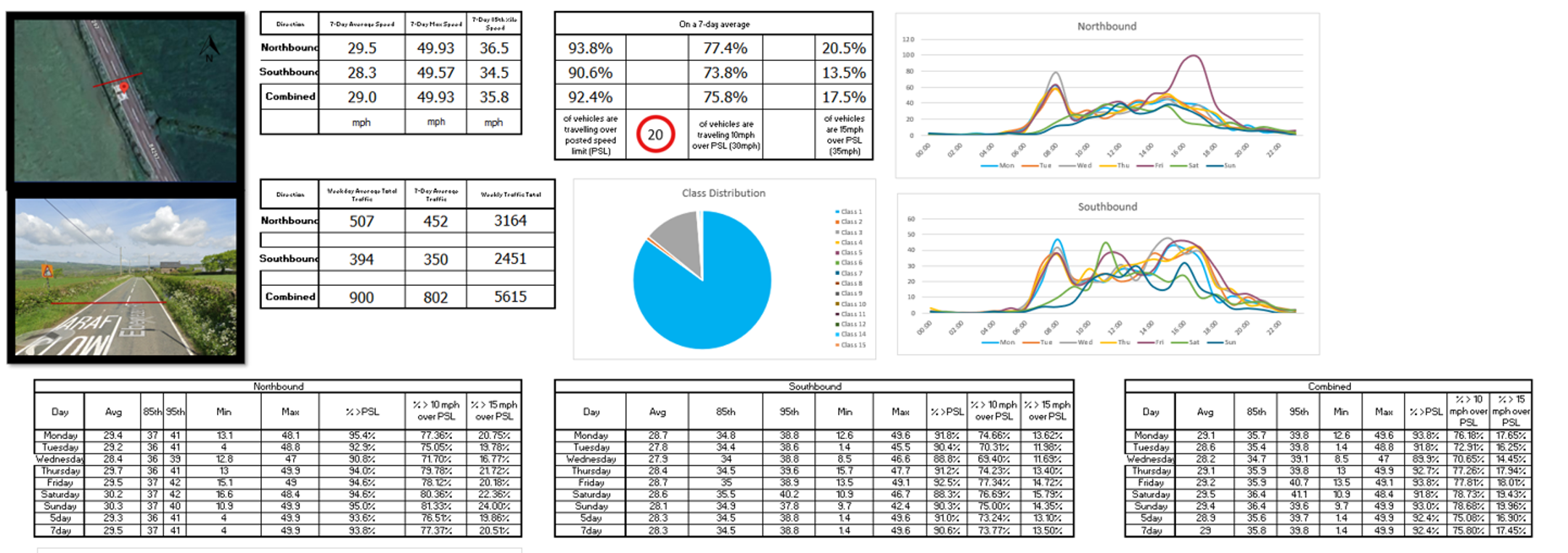
|
Class |
Vehicle Description |
Total |
|
Class 1 |
Short - Car, light Van |
4772 |
|
Class 2 |
Short Towing - Trailer, Caravan, Boat, etc. |
48 |
|
Class 3 |
Two axle truck or Bus |
723 |
|
Class 4 |
Three axle truck or Bus |
14 |
|
Class 5 |
Four axle truck |
4 |
|
Class 6 |
Three axle articulated vehicle or Rigid vehicle and trailer |
5 |
|
Class 7 |
Four axle articulated vehicle or Rigid vehicle and trailer |
10 |
|
Class 8 |
Five axle articulated vehicle or Rigid vehicle and trailer |
1 |
|
Class 9 |
Six (or more) axle articulated vehicle or Rigid vehicle and trailer |
2 |
|
Class 10 |
B-Double or Heavy truck and trailer |
0 |
|
Class 11 |
Double road train or Heavy truck and two trailers |
0 |
|
Class 12 |
Triple road train or Heavy truck and three (or more) trailers |
0 |
|
Class 14 |
Motorcycle |
23 |
|
Class 15 |
Cycle |
13 |
Response 5:
I can confirm that Dyfed-Powys Police does not hold the information requested, due to the fact that there have been no recorded injury collisions on the B4297 through Llanedi in the last 5 years.
Response 6:
I can confirm that Dyfed-Powys Police does hold the information requested, as outlined below.
All deployment was near the school on the B4297 in Llanedi.
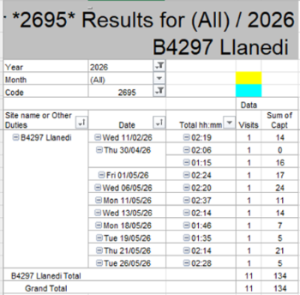 |
Response 7:
I can confirm that Dyfed-Powys Police does not hold the information requested, this is due to the fact that we do not keep a record of the speeds of the offending vehicles. This information may be available from the Central Ticket Office in Trefforest.
Response 8:
I can confirm that Dyfed-Powys Police does hold the information requested, as outlined below.
Please refer to the link in response 1 & 2: As per the Wales Road Casualty Reduction Partnership Safety Camera Enforcement Site Criteria and Site Management Policy, the site on the B4297 at Llanedi is an operation site (page 7 sec 4.4).
An operation-based site is one which is chosen for a specific initiative to target the anti-social use of vehicles. As this form of enforcement is targeting a specific problem, enforcement will be targeted and intelligence-led and may be designed to complement existing operations, for example, operations “Night Owl3”, “Darwen”4 and “Focus”5. This may also include sites specifically targeting other offences within the “fatal five6” such as non-use of seatbelts and/or use of mobile phones. Operations will be planned in advance on the operations calendar and in conjunction with ACPO and TISPOL campaigns as well as operations decided on local intelligence. This type of enforcement will be in support of police operations and may entail police use of GoSafe equipment to carry out enforcement at non-camera sites. This element of the enforcement will be decided on an operation-by-operation basis and will be in partnership with the relevant police force. The effectiveness of all operations will be monitored. As the police can enforce at any site at any time without any signage or conspicuity rules, this enforcement may not be supported by the use of camera graphic signage7. Operations will not be subject to full speed surveys but may be supported by shorter speed surveys where they are deemed operationally necessary.
Response 9:
I can confirm that Dyfed-Powys Police does not hold the information requested, this is due to the fact that Carmarthenshire County Council are responsible for traffic calming measures and may hold this information.
Response 10:
I can confirm that Dyfed-Powys Police does not hold the information requested, this is due to the fact that there are no documents held that directly compare the enforcement site at Llanedi with other sites.
This is a response under the Freedom of Information Act 2000 and disclosed on 05/08/2026.
|
Os oes angen y wybodaeth yma arnoch yn Gymraeg, cysylltwch â: If you require this information in Welsh, please contact: |